Set cold.
Run hot.
Measure everything.
The tyre pressure calculator for track days and club racing. Free, no account, works offline in the paddock.
Grip is a temperature. Watch the answer move.
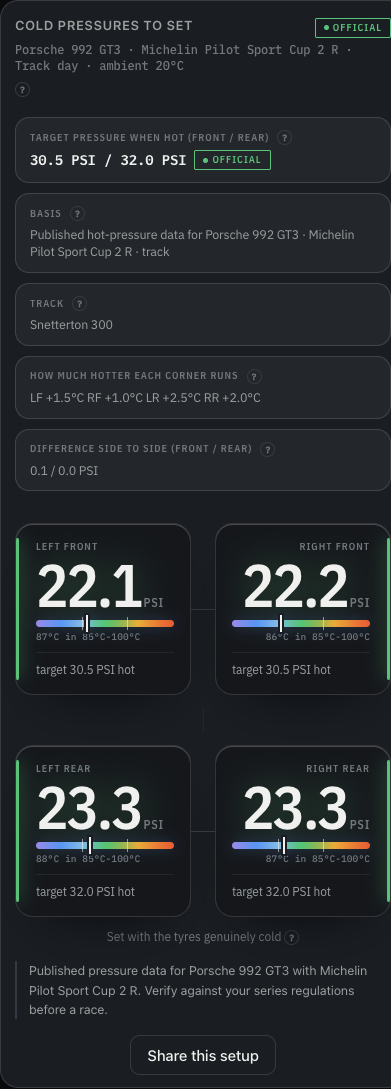
A tyre only reaches its working pressure hot, so the cold figure is derived from the hot target. Below is a published set for the Porsche 992 GT3 on Michelin Pilot Sport Cup 2 R, computed with the same gas law the app ships. Drag the ambient temperature and watch the morning's answer change.
Four pieces. One method.
Cold pressures worked back from the hot target for your car, tyre and circuit. Ten seconds, works offline in the paddock.
02 AnalysisPyrometer readings across each tread become pressure and camber calls, scored against the tyre's window, kept session over session.
03 Circuit sheetsHow much hotter each corner runs at every major UK venue and beyond, with a worked example per circuit computed by the engine.
04 The open databaseEvery published pressure set and tyre window the engine computes from, published in full. Nothing up the sleeve.
Three steps between the van and the out lap
Car, tyre, circuit, and whether today is a track day, a race or the road. Circuit data pre-fills how much hotter each corner runs at 45 circuits; enter your own deltas anywhere else.
The hot target is restated for the day's ambient temperature, corner by corner. Set the figures with the tyres genuinely cold, and note the target hot pressures for the pit-lane check.
After the session, pyrometer readings across each tread become pressure and camber calls. From here your own measurements outrank the model, and your history builds session over session.
Published sets where they exist, and sources shown always
| VEHICLE | TYRE | USE | HOT F/R, PSI | AT, °C |
|---|---|---|---|---|
| Porsche 992 GT3 | Michelin PS Cup 2 R | track | 30.5 / 32.0 | 92 |
| Porsche 992 GT3 Cup | Pirelli P Zero DHD | race | 29.0 / 31.0 | 90 |
| Porsche 718 Cayman GT4 | Michelin PS Cup 2 R | track | 29.0 / 30.5 | 88 |
| Ferrari 296 GT3 | Pirelli P Zero DHE | race | 31.0 / 32.5 | 88 |
| BMW M4 GT3 | Pirelli P Zero DHE | race | 30.5 / 32.0 | 90 |
| Ginetta G55 GT4 | Avon ZZR | race | 27.0 / 28.5 | 85 |
| MX-5 ND | Yokohama Advan A052 | track | 28.0 / 28.0 | 85 |
Excerpt. 27 published hot-pressure sets are carried verbatim and verified against their sources in the engine's test suite; the remaining combinations are estimated from class baselines and labelled as such.
424 CARS 67 TYRES 45 CIRCUITS 27 PUBLISHED SETS
Every figure declares its source
Most calculators hand you a number and let you assume it is gospel. GripCalc marks each one, and when the model reaches the edge of what it can defend it shows a band and says so, rather than inventing precision.
A published hot-pressure set exists for this exact car, tyre and usage. The strongest source in the database.
Derived from the vehicle class and weight distribution. Right area, not exact: treat the first session as a measurement run.
Readings you took on your car on the day. They outrank everything above, and the analysis works from them the moment they are entered.
On the road your placard is the authority, so nothing is estimated: the handbook figure is adjusted for temperature, because a garage-set pressure reads low on a cold morning.
Dialled in for the UK paddock
UK · Silverstone GP · Silverstone National · Silverstone International · Donington Park GP · Donington Park National · Brands Hatch GP · Brands Hatch Indy · Snetterton 300 · Snetterton 200 · Oulton Park International · Oulton Park Island · Oulton Park Fosters · Cadwell Park · Croft · Thruxton · Anglesey Coastal · Anglesey National · Bedford Autodrome GT · Bedford West · Bedford East · Castle Combe · Knockhill · Pembrey · Lydden Hill
ABROAD · Spa-Francorchamps · Nürburgring GP · Nürburgring 24H · Monza · Zandvoort · Portimão · Imola · Mugello · Paul Ricard · Hungaroring · Red Bull Ring · Zolder · Magny-Cours · Barcelona · Laguna Seca · Road America · Watkins Glen · Sebring · COTA · VIR
Each carries corner temperature deltas to start from. Somewhere else? Enter your own and the method is unchanged.
Track day, race, road
Conservative hot targets with margin for error and longer tyre life. The default, and the right call for most days.
Hot targets around 1 to 2 psi higher for response and consistency, accepting faster wear. Verify against your series regulations.
No derivation at all: your handbook placard, restated for today's temperature. The calculator knows when not to calculate.
Works where the signal does not
GripCalc installs as an app on iPhone, iPad and Android. Open it once with signal and everything works offline afterwards: calculator, pyrometer analysis and session history, all stored on your device. Nothing to sign into with cold hands. The calculator needs no account at all, and a Pro membership signs in once at home and then stays put all weekend, signal or no signal.
Asked in every paddock
- 7.1What tyre pressures should I run on a track day?
- It depends on the pressure your tyres should reach when hot, which varies by car, tyre and circuit. GripCalc works backwards from that hot target to a cold pressure for today's ambient temperature. Most road-based track cars end up several psi below their road placard cold, then check hot pressures after the first session.
- 7.2Is it really free?
- Yes. The calculator is free to use, with no account, and your sessions are stored on your own device.
- 7.3How accurate is it?
- Honest answer: it depends on the source, which is why every number is labelled. Published data where it exists, class-based estimates elsewhere, and a clear warning when the model is at its limit. The recommendation gets you a safe first session; your pyrometer readings then replace the model with measurements, which beat any calculator.
- 7.4Does it work offline at the circuit?
- Yes. Installed as an app it works fully offline after one load with signal, including the calculator, analysis and history.
- 7.5Can I use it for road pressures?
- Road mode takes your handbook placard figures and adjusts them for temperature. It never estimates road pressures: the placard is the right source, and a pressure set in a warm garage reads low on a cold morning.
- 7.6What kit do I need for the full method?
- A decent pressure gauge for the pit-lane hot checks, and a probe-type pyrometer for reading tread temperatures. The app's Kit section lists what earns a place in the box, what makes a good one, and roughly what it costs.